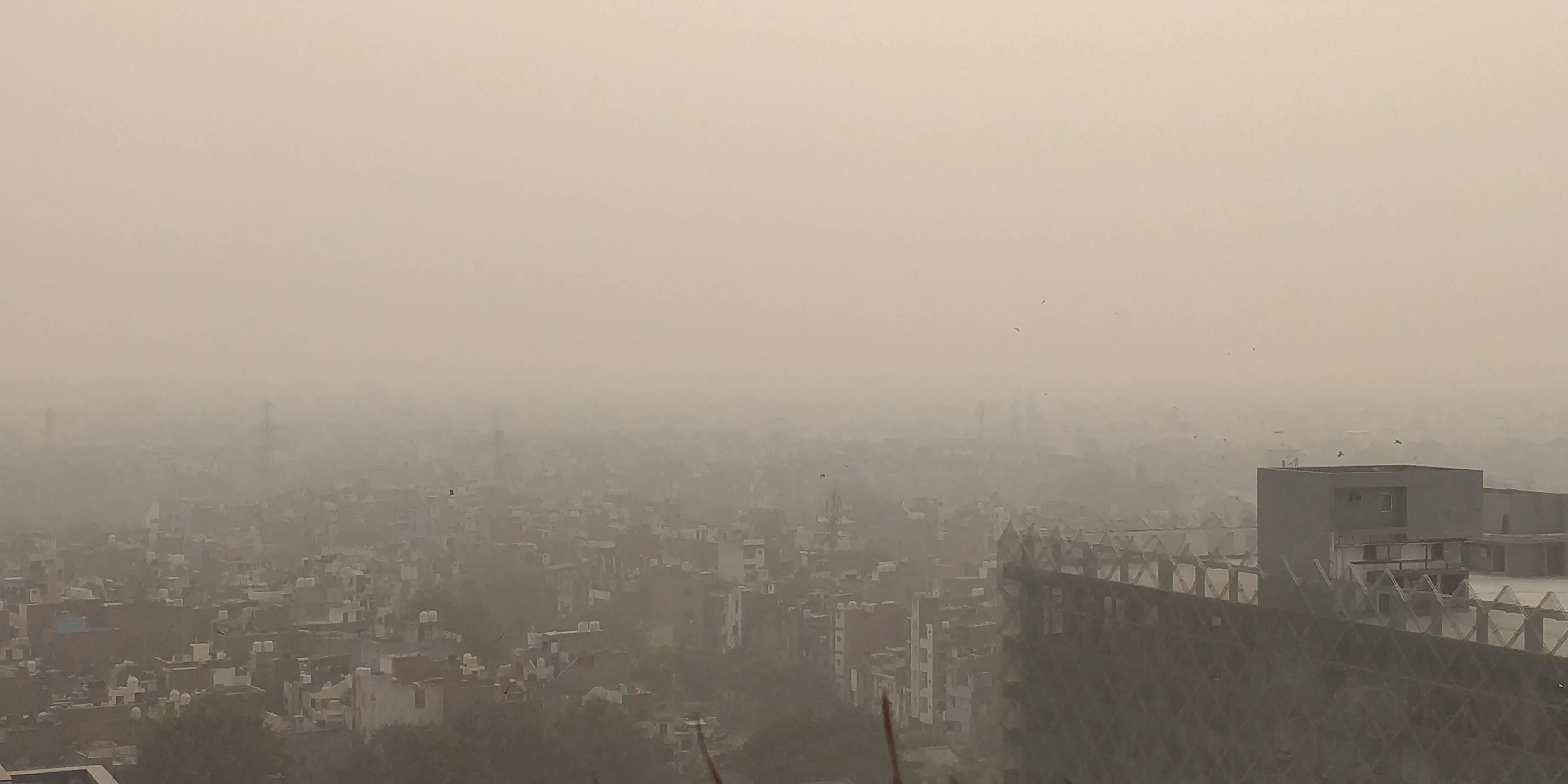
Delhi is a Gas Chamber by Design. Here Is How We Dismantle It
Delhi is in the heart of the Indo-Gangetic Plain, flanked by the Himalayas to the northeast and the Aravalli range and central plateaus to the south. This forms a vast landlocked basin. Unlike Surat or Mumbai, which benefit from dynamic sea breezes that disperse pollutant particulates out to sea, Delhi has nowhere to vent its air. Polluted air from Pakistan, Punjab, and Haryana rolls eastward down the plain, hits the barrier, and pools directly over Delhi and the NCR.
Normally, warm air rises, carrying smoke and other pollutants high into the atmosphere, where upper-level winds blow them away. In late autumn, three meteorological phenomena prevent this from happening in Delhi.
As winter approaches, the air layer near the ground gets cold; meanwhile, the layer of air above remains warm. Warm air is lighter than cold air, so it acts like a giant, invisible lid trapped across the NCR. Any smoke released at ground level cannot punch through this ceiling; it is trapped in the bottom few hundred meters.
At this time of the year, wind speed drops to near zero in North India. Without horizontal winds to blow the pollutants away, the air becomes completely stagnant.
Rising humidity mixes with dust and chemical emissions to form dense smog. In this smog, volatile gases undergo photochemical reactions to form fine secondary particulate matter (PM2.5), multiplying the particle density and thickening the smog.
And then there are multiple human factors adding fuel to an already combustible situation.
Under the Punjab Preservation of Subsoil Water Act, farmers must delay paddy transplanting to late June to conserve groundwater. This pushes harvest into late October and early November, leaving only a 15–20 day window to prepare fields for the upcoming winter wheat crop. Farmers are in a hurry, and burning the leftover stubble is the fastest, cheapest method. The northwest winds prevalent around the winter carry this smoke straight into Delhi.
Delhi has over 10 million registered vehicles, plus hundreds of thousands of interstate diesel trucks cut through the NCR every night. Their exhaust pumps out ultrafine carbon, NOx, and benzene directly into the air.
Roughly 30–40% of Delhi’s ambient PM10 is mechanical dust churned up by unpaved road shoulders, heavy traffic, and uncontained construction activity.
Add to all of this the acute spike from Diwali firecrackers. While seasonal bans exist on paper, the lack of border enforcement turns Diwali into an immediate chemical shockwave atop an already suffocating baseline.
So the million-dollar question: can Delhi’s air problem be solved, and how?
Yes, it can absolutely be solved given the willingness of those involved. Here is how it can be done in ten years:
Phase 1 (Years 1–3): Supersede state borders and create the unified airshed authority. Disband the current toothless advisory committees and empower the unified airshed authority with judicial and fiscal authority over the entire NCR airshed (Delhi, Punjab, Haryana, Western UP, and parts of Rajasthan). No state government can veto its mandates.
Farmers burn stubble because clearing it mechanically costs money. Rather than penalizing them, create an ex-situ market. Make it mandatory for every thermal power plant and cement factory within 300 km to co-fire a minimum of 10% crop-waste biomass at a guaranteed purchase price.
Gradually move agricultural MSP procurement away from water-guzzling paddy in Punjab and Haryana toward pulses, millets, and oilseeds that don’t produce massive silica-rich stubble and don’t drain the water table.
Complete bio-mining of the mega-landfills.
Ban the firecrackers. Diwali is a festival of light and not the noise.
Phase 2 (Years 4–6): Mandate that 100% of DTC buses, last-mile commercial delivery vans, and auto-rickshaws must be electric.
Establish an ultra-low emission zone inside Delhi’s inner ring. High-emission diesel commercial vehicles pay an exorbitant fee to enter; clean electric vehicles enter free.
Complete orbital freight corridors around Delhi so no long-haul diesel trucks need to cross through Delhi’s territory unless delivering directly to the city.
Mandate complete conversion to PNG or electricity for all micro-scale industrial units and furnaces within a 150 km radius. Mandate that brick kilns switch entirely to fly-ash brick manufacturing.
Phase 3 (Years 7–10): Road dust is a solvable engineering problem. Mandate wall-to-wall paving. No exposed dirt patches between the asphalt and pedestrian sidewalks. Every unpaved median must be converted to deep plantation cover or paved over.
Ban dry broom sweeping across the NCR roads, which simply launches settled fine dust back into the air. Replace it entirely with mechanized vacuum sweepers with dust suppression.
Plant a multi-tiered regional green belt with grasses, shrubs, and native trees with high dust-trapping leaf morphology like Peepal, Neem, and Amaltas along major highway corridors and surrounding industrial zones to serve as physical particle filters.
Decommission every coal-fired thermal power plant within a 250 km radius, transitioning the NCR’s baseload power to nuclear, solar, and grid-scale storage.
If this gets done, it is our absolute belief that Delhi will forever be free from its air pollution.
Will those in positions of powers do this? Yes, absolutely, if we make it the number one point upon which we will vote in the upcoming elections; otherwise, no. It’s up to us to decide the quality of air our children and grandchildren will be breathing.