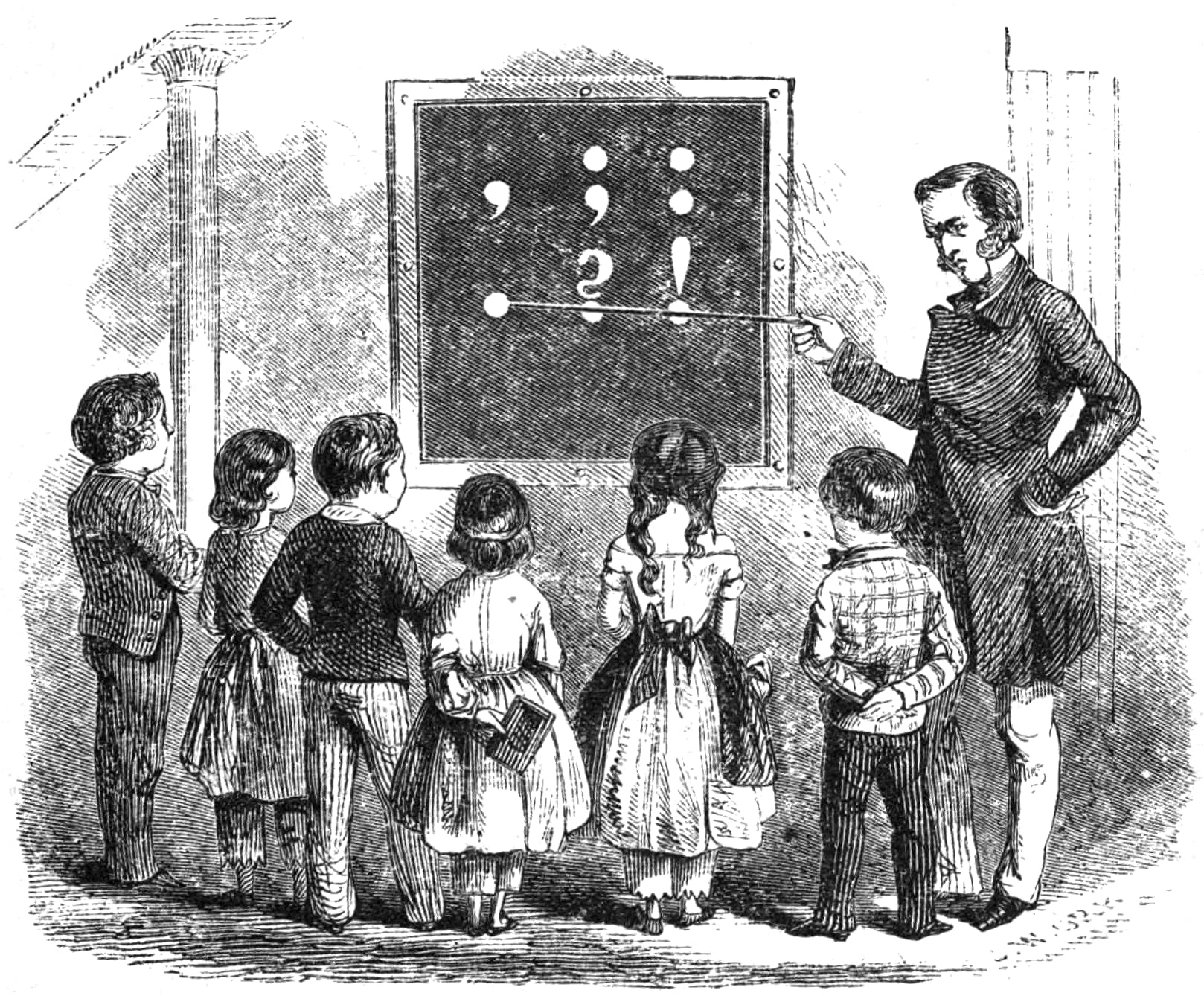
Breathe Here: Punctuation Marks Explained Once and For All
Before punctuation was standardised, scribes wrote in scriptio continua — continuous script, no spaces between words, no marks between thoughts. Reading was an act of decoding. You had to speak the text aloud to find where one thought ended and another began. Punctuation did not arrive to impose rules. It arrived to give the reader permission to breathe.
That is what every mark on this list does. Not one of them is arbitrary. Not one of them is decorative. Each one is a signal — a precise instruction from the writer to the reader: pause here, stop here, lean in here, this is extra, this changes everything. When punctuation goes wrong, the reader stumbles. When it goes right, they never notice it at all — they simply understand.
This is not a grammar textbook. It is a conductor’s score. By the end of it, every mark will feel not like a rule to remember but like a tool you have always owned and are only now learning to hold correctly.
A note on dialect: British and American English differ meaningfully on punctuation — particularly on quotation marks and the placement of other marks around them. Both conventions are covered. Neither is wrong.
I. The Pauses
These are the marks that slow the reader down — that introduce a breath, a beat, a moment of organisation before the sentence continues. They are the most used marks in the language and the most frequently mishandled, because their job requires judgment rather than a simple rule.
The Comma ,
The comma is the most versatile mark in written English — and therefore the most abused. It does not mean pause wherever I would pause if speaking. It means something precise in every context it appears, and those contexts are distinct.
The list comma separates items in a series of three or more.
She packed a torch, a compass, a blanket, and three days of food.
Each item is separated from the next by a comma. Simple, foundational, uncontroversial — until the last comma.
The Oxford comma — also called the serial comma — is the comma placed before the final and (or or) in a list. It is standard in American English and academic writing; it is optional but widely used in British English. The argument for it is not stylistic — it is logical. Without it, the final two items in a list can appear to be in apposition (explaining or identifying each other) rather than separate. The famous illustration:
We invited the strippers, Stalin and the Pope.
Without the Oxford comma, Stalin and the Pope appear to be the strippers. With it — the strippers, Stalin, and the Pope — they are three distinct guests. The Oxford comma will never create ambiguity. Its absence sometimes will.
Wrist tattoo: In any list, if removing the final comma before and could cause the last two items to look like a pair rather than two separate things, keep it. When in doubt, keep it.
The clause-separating comma joins two independent clauses connected by a coordinating conjunction — and, but, or, nor, for, yet, so. The comma goes before the conjunction.
She finished the manuscript, and her editor wept with relief.
Without the comma, the sentence is technically a run-on. But the comma is only warranted here when both sides are full independent clauses — each with its own subject and verb. She finished the manuscript and sent it needs no comma: sent it has no subject of its own.
The introductory comma follows an introductory word, phrase, or clause at the beginning of a sentence — a signal that the introduction has ended and the main clause is about to begin.
After three years of silence, she finally wrote. Honestly, I had no idea. When the fog lifted, the harbour appeared.
Short introductory phrases (two or three words) sometimes manage without the comma; longer ones always need it; any introductory clause with a verb needs it.
The non-restrictive comma — perhaps the most elegant comma job of all — sets apart a clause that adds information without changing the essential meaning of the sentence. If the clause could be lifted out and the sentence would still say the same thing about the same person or object, it is non-restrictive and belongs in commas.
My sister, who lives in Edinburgh, is a surgeon.
Remove who lives in Edinburgh and the sentence still identifies the same sister. The clause is extra — a parenthetical in comma form. (This connects directly to the which/that distinction in our companion article: non-restrictive clauses use which, set off by commas; restrictive clauses use that, with no commas.)
The comma splice — the error — is what happens when two independent clauses are joined by a comma alone, with no conjunction.
She finished the manuscript, her editor wept with relief. ✗
This is the comma splice. The comma is not strong enough to hold two complete sentences together without help. There are exactly three ways to fix it:
- Replace the comma with a full stop: She finished the manuscript. Her editor wept with relief.
- Replace the comma with a semicolon: She finished the manuscript; her editor wept with relief.
- Add a conjunction after the comma: She finished the manuscript, and her editor wept with relief.
All three are correct. The choice is a matter of rhythm and the relationship you want to signal between the two thoughts.
Wrist tattoo: A comma alone cannot hold two complete sentences together. If both sides could stand alone as sentences, you need either a full stop, a semicolon, or a comma plus a conjunction.
The Semicolon ;
The semicolon is the mark everyone fears and nobody was properly taught. It sits between the comma and the full stop in weight and authority — heavier than a pause, lighter than a stop — and it does two distinct jobs, both of them elegant.
Job one: joining independent clauses. When two complete sentences are closely related in thought — so closely that a full stop would sever them too abruptly — the semicolon holds them together without the need for a conjunction. It is the mark of a relationship stated by proximity rather than by name.
She knew the answer; she said nothing.
A full stop would work. But the semicolon does something the full stop cannot: it tells the reader that these two facts belong together, that the second illuminates or answers the first, that the silence because of the knowing is the whole point. No conjunction is needed because the relationship is felt without being stated.
The morning was cold and still; the lake held the sky in its surface like a mirror.
The one rule of the semicolon: Both sides must be able to stand alone as complete sentences. A semicolon between a complete clause and a fragment is always wrong.
Job two: the semicolon in complex lists. When a list contains items that already include commas — cities with their countries, phrases with internal pauses — using commas to separate the items creates confusion about what belongs to what. The semicolon steps in as the list separator, and the commas inside each item are subordinate to it.
The delegates came from Rome, Italy; Paris, France; and Nairobi, Kenya.
Without semicolons, that sentence becomes a tangle of six apparent list items. With them, the three items are immediately clear.
Wrist tattoo: Could both sides stand alone? Then a semicolon can hold them together. Does your list contain items that already have commas inside them? Then semicolons separate the items.
The semicolon is not a weak full stop. It is not a strong comma. It is its own thing entirely — the mark of connection without explanation, the signal that says: these two thoughts are married; I trust you to see why.
The Colon :
The colon is the mark of the announcement, the promise, the reveal. It leans forward. Everything before it builds toward what comes after, and what comes after must justify the lean.
Before a list: The colon introduces a list when the preceding clause is complete and formally sets up what follows.
She needed three things: time, silence, and a better question.
Notice that she needed three things is a complete clause. The colon says: here they are. You may not use a colon between a verb and its objects, or between a preposition and its objects — because the clause before it would be incomplete.
She needed: time, silence, and a better question. ✗ — the clause before the colon is not complete. The colours are: red, blue, and green. ✗ — same problem.
Before an explanation or elaboration: The colon can introduce a clause that explains, expands, or answers the clause before it.
There was one problem with the plan: nobody had told the river.
Before a quotation: Especially in formal or academic writing, a colon introduces a quotation that the preceding clause has set up completely.
She thought of her grandmother’s words: “A closed mouth gathers no feet.”
The capitalisation question: After a colon, American style generally capitalises the first word of a complete sentence; British style generally does not unless it is a proper noun, a quotation, or a formal list. Both approaches are consistent within their own style guides.
Wrist tattoo: Read what comes before the colon. Could it stand alone as a complete thought? If yes, the colon is correct. If the clause feels unfinished — if it ends with a verb looking for its object — remove the colon and continue.
The colon is a promise. What precedes it earns the right to make that promise. What follows it must redeem it.
II. The Interrupters
These marks step aside from the main road of the sentence — or reach across it, or build bridges between its parts. They are the marks of parenthetical thought, of emphasis, of range, of construction. They are often confused with one another, and each has its own distinct character.
The Em Dash —
The em dash is the most dramatic mark in the punctuation canon. It is named for its width — the width of the letter M — and it carries that width in energy and presence. It signals an interruption, an emphasis, a pivot, or an aside that refuses to whisper.
The single em dash: the pivot or the cut. At the end of a clause, a single em dash introduces a surprise, a contradiction, a sharpening of what came before — or a sudden stop, mid-sentence, to signal that something was left unsaid.
She had planned everything perfectly — or so she believed. He opened his mouth to speak —
In dialogue or narrated thought, the single em dash cuts off. The reader feels the interruption physically. No other mark does this.
The double em dash: the dramatic parenthetical. Two em dashes enclose a parenthetical remark — an aside, an interruption of the main clause — the way commas do, but with more force. The content inside em dashes is not whispering extra information; it is stepping forward, briefly, before stepping back.
The solution — and she had known it all along — was to start from the beginning.
Compare this to the comma version: The solution, and she had known it all along, was to start from the beginning. The commas are quieter. The em dashes say: this matters; notice this.
The tone spectrum: em dash, comma, parentheses. These three marks all do parenthetical work, but at different volumes.
- Commas are the quietest — they fold extra information into the sentence without drawing attention.
- Parentheses whisper — they signal that what is inside is genuinely secondary, a footnote in the flow of the text.
- Em dashes speak at full voice — they say: this aside is worth pausing for.
Wrist tattoo: Em dash = drama and emphasis. Comma = quiet fold. Parentheses = genuine aside. Choose the volume you want.
A note on formation: The em dash has no spaces around it in American English. British style sometimes uses the spaced en dash ( – ) in its place — the preference varies by publisher. Use whichever your style guide prescribes; be consistent.
The En Dash –
The en dash is the middle child — longer than a hyphen, shorter than an em dash, doing its own specific work with quiet professionalism. It is named for the width of the letter N.
Ranges. The en dash connects two ends of a range: numbers, dates, times, pages. It means through or to.
2019–2026 pages 14–22 Monday–Friday 9:00–17:00
A hyphen here is technically incorrect, though many style guides accept it in informal contexts.
Compound adjectives with multi-word elements. When one part of a compound adjective is itself more than one word, a hyphen between them is insufficient — an en dash is used to signal that the compound spans a wider construction.
post–World War II architecture Nobel Prize–winning research New York–based company
Versus and connection. The en dash can indicate a connection or contrast between two things of equal weight.
the London–Edinburgh train the conservative–liberal coalition
Wrist tattoo: En dash = range, span, multi-word compound. Hyphen = simple joined compound. Em dash = interruption and emphasis. Three marks, three jobs, no overlap.
The Hyphen ‑
The hyphen is the builder, the joiner, the mark that constructs compound words and holds them together long enough to be understood. It is the most positional mark in the language — what a compound does with a hyphen often depends entirely on where it sits in the sentence.
Compound adjectives before a noun. When two or more words function together as a single adjective before a noun, they hyphenate.
a well-known writer a first-rate solution a fast-moving story
Compound adjectives after a noun. When the same compound adjective follows a linking verb — when it is not directly modifying a noun but is the predicate — the hyphen is dropped.
The writer is well known. The solution was first rate. The story was fast moving.
This is one of the most consistently misapplied rules in English, and the test is simple: is the compound sitting directly before its noun? Hyphenate. Has it moved to after the verb? Let it stand free.
Compound nouns: the three-stage life of a word. Many compound nouns begin as two separate words (book shelf), acquire a hyphen as they become established (book-shelf), and finally fuse into one word (bookshelf) as they become completely naturalised. There is no formula — the dictionary is the authority here — but knowing that these three stages exist explains why compound nouns seem inconsistent.
The suspended hyphen handles the elegant case where two or more hyphenated compounds share the same second element.
first- and second-year students three- to five-bedroom houses
The hyphen after first and after three hangs in suspension, holding a place for the second element that both compounds share. Without it: first and second-year students — which makes it look as if only second-year is hyphenated.
Numbers and fractions. Compound numbers from twenty-one to ninety-nine are hyphenated. Fractions used as adjectives are hyphenated: a two-thirds majority. Fractions used as nouns are not: two thirds of the vote.
Wrist tattoo: Compound adjective before a noun → hyphenate. After a verb → no hyphen. Check the dictionary for compound nouns. Numbers twenty-one to ninety-nine always hyphenate.
Parentheses ( )
Parentheses are the whisper. They signal to the reader: what follows is genuinely secondary — useful, perhaps, but not essential to the sentence’s core meaning. Where em dashes reach forward to be noticed, parentheses step back to avoid imposing.
What belongs inside parentheses: clarifications, asides, abbreviations, examples, dates, cross-references — anything that enriches but does not carry.
The treaty was signed in 1648 (though ratified only the following spring) and remained in force for a century. The document used ISO 8601 (the international date format standard) throughout.
The punctuation question: inside or outside? If the parenthetical is a complete sentence standing alone, the full stop goes inside the closing parenthesis. If the parenthetical is embedded within another sentence, the punctuation for the surrounding sentence goes outside.
She was exhausted. (She had not slept in two days.) — complete sentence: full stop inside. She was exhausted (she had not slept in two days), but she kept going. — embedded: comma outside, no mark inside.
Parentheses within parentheses: avoid them when possible; when unavoidable, use square brackets inside parentheses.
(For a fuller treatment of this subject, see the appendix [pages 234–251].)
Wrist tattoo: Is the aside genuinely secondary, a footnote in the flow? → parentheses. Does the aside deserve to be noticed, to interrupt? → em dashes. Is it simply extra information, folded quietly in? → commas.
III. The Enders
These marks close. They signal to the reader that a unit of thought has reached its conclusion. They seem simple — and one of them is — but each carries nuance that affects the reader’s experience of the sentence’s meaning and weight.
The Full Stop / Period .
The full stop is apparently the simplest mark in the language. It ends a sentence. And yet more writing problems stem from misunderstanding what a sentence is than from almost anything else.
When to end a sentence. A sentence is a complete thought with a subject and a verb. The full stop signals that this thought is complete and that a new one is about to begin. Two errors arise from forgetting this:
The fragment — a group of words punctuated as a sentence but missing a subject, a verb, or both.
Running through the rain. — no subject, no main verb. Which she had known all along. — a subordinate clause, not a sentence.
Fragments are not always errors in creative writing — skilled writers use them deliberately for effect. But they are errors when they are not deliberate, and the test is always: does this have a subject and a main verb? Can it stand completely alone?
The run-on — two complete sentences fused without any punctuation between them, or with only a comma (the comma splice, covered above).
She finished the manuscript her editor wept with relief. — a run-on. Two sentences, no separator.
Abbreviations. In American English, abbreviations typically take a full stop: Mr., Dr., etc., U.S.A. In British English, abbreviations that end on the same letter as the full word do not: Mr, Dr, St. Abbreviations that are truncated do: Prof., etc., approx. The logic is elegant: if the abbreviation’s last letter is the word’s last letter, no stop is needed because nothing has been omitted at the end.
When a sentence ends with an abbreviation that already carries a full stop, no second stop is added: She listed Paris, London, Rome, etc. — one stop serves both.
Wrist tattoo: Does your sentence have a subject and a main verb and express a complete thought? → full stop. Fragment or run-on → fix first.
The Question Mark ?
The question mark ends a direct question. It is placed at the end of an interrogative sentence — one that asks something directly.
Direct vs indirect questions. A direct question is asked openly, in its own sentence. An indirect question is embedded within a statement.
Where did she go? — direct question: question mark. He asked where she had gone. — indirect question: full stop. The asking is reported; no question is posed to the reader. I wonder whether she’ll come. — indirect: full stop. Will she come? I wonder. — direct: question mark after the direct question, full stop after the statement.
The rhetorical question. A rhetorical question expects no answer — it uses the form of a question to make a statement. It takes a question mark, because it is grammatically interrogative, even if the answer is understood.
Was this really the best they could do?
In creative writing, a rhetorical question is occasionally ended with a full stop for deliberate flat effect. This is a stylistic choice, not standard practice.
Courtesy questions. Would you please close the door. is technically a polite request, not a question — many writers give it a full stop to reflect this. Would you please close the door? is also acceptable; the question mark here signals openness to refusal.
Wrist tattoo: Is the question directly posed to the reader or the listener? → question mark. Is it reported, embedded, or wondered about? → full stop.
The Exclamation Mark / Exclamation Point !
The exclamation mark began life as the Latin word io — an exclamation of joy — written one letter above the other until they merged into a mark. It signals genuine surprise, urgency, strong emotion, or a raised voice. And like a raised voice, it loses all power through overuse.
The rule of restraint. One exclamation mark does the work of ten, because it signals that this moment — above all others in the text — warrants it. Two in a row is never correct in formal writing. Three is typographic shouting that no reader takes seriously. A page full of them tells the reader that the writer has cried wolf so many times that no wolf will ever arrive.
“Cut out all those exclamation marks. An exclamation mark is like laughing at your own joke.” — F. Scott Fitzgerald, paraphrased and permanent.
Exclamation marks in dialogue vs prose. In fiction, exclamation marks in dialogue can signal a character’s raised voice or strong emotion — but even here, restraint produces more powerful writing than abundance.
“The bridge is out!” she screamed.
In narrative prose — in essays, journalism, non-fiction — the exclamation mark is almost always replaceable by a stronger verb or a more precisely chosen word. If the content is genuinely startling, the content will do the work. The mark is the scaffolding, not the building.
Wrist tattoo: Is this the single most surprising or emphatic moment in this entire piece of writing? → one exclamation mark. Is it one of several moments of heightened emotion? → choose stronger words and trust them.
IV. The Holders
These marks contain — they hold something within them, whether a voice, a possession, an editorial note, or a contraction. They are marks of relationship: between a word and what it owns, between a text and what it quotes, between an editor and what they have found.
Quotation Marks “ “ / ’ ’
Quotation marks hold spoken or written words that are not the narrator’s or writer’s own. They also serve a range of secondary functions, and they are the mark most divided by dialect.
Double or single? American English uses double quotation marks for primary quotation and single for a quotation within a quotation. British English traditionally uses single for primary and double for a quotation within a quotation — though many British publishers now use double throughout.
American: “She said, ‘Don’t wait for me,’ and was gone.” British: ‘She said, “Don’t wait for me,” and was gone.’
The punctuation placement split — and the logic behind it. This is the most significant difference between American and British quotation practice, and it is worth understanding rather than simply memorising.
American convention (typesetters’ logic): Commas and full stops go inside the closing quotation mark, regardless of whether they are part of the quoted material.
She called it “a disaster,” and moved on. The note read “do not disturb.”
British convention (logical): Commas and full stops go inside the closing quotation mark only if they are part of the quoted material. If they belong to the surrounding sentence, they go outside.
She called it ‘a disaster’, and moved on. The note read ‘do not disturb’. Did she say ‘don’t wait’? — the question mark belongs to the surrounding sentence, so it goes outside.
The British approach is logically defensible; the American approach is historically rooted in typesetting aesthetics (the period and comma protected the fragile type of quotation marks when set in metal). Both are internally consistent. Neither is wrong within its own system.
Quotation marks for titles. Short works — articles, short stories, poems, episodes, songs — take quotation marks. Long works — books, films, albums, newspapers, plays — take italics.
She read “The Dead” in Dubliners before the film was released.
Scare quotes — quotation marks placed around a word to signal irony, doubt, or distance from the word’s standard meaning.
The “solution” they proposed made everything worse.
Scare quotes are a tool of precision when used sparingly. Overused, they become a nervous tic that signals a writer who doesn’t trust their own vocabulary.
Wrist tattoo: Primary quote: double (American), single (British). Quote within a quote: the other kind. Punctuation placement: inside always (American), inside only if it belongs there (British).
The Apostrophe ’
The apostrophe does two jobs. It has never, in either job, indicated a plural. This is the foundational truth of the apostrophe, and it is violated on signs, menus, and informal notices everywhere in the English-speaking world.
Job one: possession. The apostrophe-S signals that what follows belongs to what precedes.
- Singular noun: add ’s → the cat’s bowl, the city’s streets, James’s coat
- Plural noun ending in S: add only the apostrophe → the cats’ bowls, the cities’ streets
- Plural noun not ending in S: add ’s → the children’s shoes, the women’s vote
- Its as a possessive: no apostrophe → the cat licked its paw
The James question. For singular nouns ending in S, style guides diverge: James’s or James’? Most modern style guides, including the Chicago Manual of Style, recommend James’s on the grounds that it reflects pronunciation — we say JAY-miz-iz, not JAY-miz. The apostrophe-only form (James’) is also widely used and accepted. Choose one and be consistent.
Job two: contraction. The apostrophe marks the place where letters have been omitted in a contraction.
it is → it’s you are → you’re they are → they’re do not → don’t cannot → can’t of the clock → o’clock
The apostrophe in a contraction stands in place of the missing letters, at the exact point of omission.
What the apostrophe never does: plurals. Nouns form their plurals with S or ES alone, no apostrophe.
the 1990s (not the 1990’s) CDs (not CD’s) three coffees (not three coffee’s)
The only exception some style guides allow is to prevent misreading: dot your i’s and cross your t’s — the apostrophe here prevents is being read as the verb. This exception is narrow and specific.
Wrist tattoo: Apostrophe = possession or contraction. Never = plural. Its is the possessive (like his, her, their — none of which take an apostrophe). It’s = it is or it has only.
Square Brackets [ ]
Square brackets are the editor’s mark — the signal that something has been added to quoted material by someone other than the original speaker or writer. They are marks of transparency and scholarly honesty.
Interpolation within a quotation. When a quotation requires a word or phrase of context that was not in the original — to clarify a pronoun, to identify someone named by the original speaker, to maintain grammatical sense when the sentence has been shortened — square brackets hold the addition.
“She [the director] was adamant that the project would be completed on time.” “The council voted in favour [of the proposal] by a narrow margin.”
The editorial [sic]. When a quoted text contains an error — a spelling mistake, a grammatical slip, a factual inaccuracy — and the quotation is being reproduced exactly, [sic] (Latin for thus, meaning thus it was in the original) signals to the reader that the error is the original’s, not the editor’s.
The letter read: “I have always payed [sic] my taxes on time.”
Brackets within parentheses. When a parenthetical remark itself requires a parenthetical, square brackets nest inside the outer parentheses to avoid the visual confusion of doubled rounded brackets.
(See the companion article on homophones [published March 2026] for a fuller treatment.)
Wrist tattoo: Round parentheses = your own aside. Square brackets = your addition to someone else’s words, or nesting inside round parentheses.
V. The Specialist Marks
These marks are used less frequently than the ones above, but each has a precise job that no other mark can do. Some of them — the ellipsis particularly — are overused in casual writing to the point where their meaning has blurred. Understanding what they were designed for makes them useful again.
The Ellipsis …
Three dots. Always three. The ellipsis has two distinct functions, and the overuse that has made it a verbal tic in informal writing has nothing to do with either of them.
Omission within a quotation. When reproducing a quoted passage and removing material that is not relevant to the point being made, the ellipsis marks the gap. The omission must not change the meaning of the passage or misrepresent the original speaker.
“Four score and seven years ago our fathers brought forth… a new nation, conceived in liberty.”
Trailing off. In fiction and informal writing, the ellipsis signals a voice or thought that fades — a sentence that is not concluded, a trailing into silence or uncertainty.
She opened the door and looked in. “Oh,” she said. “Oh, I see…”
Three dots. The ellipsis is not four dots, not five, not a row of them filling the line. Three dots, and they are a single character (…), not three separate full stops typed in sequence — though in many fonts and publishing contexts the latter is accepted.
Spacing. American style typically uses the ellipsis without spaces between the dots (…) or as the single character (…). British style and many other conventions place thin spaces between the dots (* . . .*) or treat them as a single unit. Follow your style guide; be consistent.
The ellipsis in casual writing — and its collapse. In text messages and informal digital writing, the ellipsis has become a general-purpose pause, hesitation marker, and tone-setter — often used where a comma, full stop, or simply nothing would serve better. This is not wrong in casual contexts, but it has diluted the mark’s specific power in formal writing. Know the difference between the two registers.
Wrist tattoo: Ellipsis = omission from a quotation, or a voice trailing into silence. Three dots only. Everything else it has become in digital writing is a different creature entirely.
The Slash /
Also called the solidus, the forward slash, or the oblique, the slash is a mark of alternatives, fractions, abbreviations, and — in one specific context — line breaks in quoted poetry.
And/or. The slash here means one or both — it holds two options in place simultaneously. And/or is a useful construction in legal and technical writing, where the logical precision matters. In literary or formal prose, it is generally better to spell out the relationship: one or both, either or both, and perhaps also.
Fractions and numerical expressions. 3/4, 2/3, 50 km/h, £12.50/hour — the slash separates numerator from denominator, and quantity from unit.
Abbreviations. c/o (care of), a/c (account), w/o (without) — standard in correspondence and notes.
Line breaks in quoted poetry. When reproducing two or more lines of poetry within running prose, rather than displayed as verse, the slash (with a space on each side) marks the line break.
Hopkins wrote of “the achieve of, the mastery of the thing!” — “Brute beauty and valour and act, oh, air, pride, plume, here / Buckle!”
Wrist tattoo: Slash = alternatives or fractions or abbreviations. In poetry quoted in prose = line break. Not a substitute for a hyphen, an en dash, or a comma.
The Asterisk *
The asterisk (from the Greek asteriskos — little star) serves three distinct functions in writing.
Footnote marker. In older typography and some non-academic publications, the asterisk marks a footnote — the note itself carrying a matching asterisk. When multiple footnotes appear on a page, the sequence * † ‡ (asterisk, dagger, double dagger) is sometimes used before numbers take over.
Redaction and omission. In journalism and edited transcripts, asterisks replace letters in words that are not being printed in full — typically profanity: f**k, b****rd. The practice signals the word’s presence without reproducing it.
Corrections in digital text. In informal digital writing, an asterisk at the beginning of a follow-up message signals a correction to what was just written: *their — meaning the writer intended their, not the word they actually used.
The Tilde, the Caret, the Pilcrow
These three live at the margins of everyday writing — present in specialised contexts, rarely needed in prose, worth knowing.
The tilde ~ In formal prose, the tilde appears most often in Spanish and Portuguese loanwords and names (mañana, São Paulo) where it modifies pronunciation. In mathematics, it means approximately. In informal digital writing it has acquired the soft, slightly ironic qualifier meaning kind of, roughly, with a wave of the hand — a usage with no foothold in standard writing but a clear expressive niche online.
The caret ^ In proofreading, the caret marks the point of insertion — where something is to be added between existing words or letters. In mathematics and computing, it denotes exponentiation. In informal writing it sometimes functions as a pointer: see above ^. It is a mark of the editor’s margin and the programmer’s keyboard, rarely of the prose page.
The pilcrow ¶ The paragraph mark — one of the oldest symbols in written English, used by medieval scribes to mark the beginning of a new section before paragraph indentation was standard. Today it lives in word processors (the Show/Hide button reveals them), in legal documents to reference specific paragraphs, and as a mark of scholarly apparatus. In the fifteenth century, it was often drawn in red ink — a little herald announcing the arrival of a new thought. The thought arrived. The herald eventually became invisible. But it is still there, if you press the button.
Wrist tattoo: These three are specialist tools. Know them. Reach for them only when they are genuinely the right instrument.
The Tone Spectrum: A Map
Because several marks share territory — parenthetical work, pause work, ending work — it helps to see them together.
For parenthetical insertions, from quietest to loudest:
Parentheses (whisper) → Commas (quiet fold) → Em dashes (full voice)
For pauses within a sentence, from lightest to heaviest:
Comma (breath) → Semicolon (lean) → Colon (announce)
For endings, from flattest to most emphatic:
Full stop (complete) → Question mark (open) → Exclamation mark (rare peak)
For joining compound elements, from narrowest to widest span:
Hyphen (single compound) → En dash (range or multi-word compound) → Em dash (interruption)
A Final Word
Punctuation did not arrive to make writing harder. It arrived to make reading possible — to give the eye the information the ear would have supplied in speech. The rise and fall of the voice, the pause before the answer, the rushing together of closely related ideas, the stop that says this thought is complete and what follows is new — all of this is encoded in these marks, quietly, in every sentence of every piece of writing that has ever been read with understanding.
You do not need to memorise these rules. You need to understand what each mark is for — what job it does for the reader, what it signals, what it promises. Once you understand the job, the choice becomes natural. The semicolon is not intimidating when you know that it says these two thoughts are married and I trust you to see why. The em dash is not confusing when you know it says this interruption is worth your attention. The apostrophe is never misused by anyone who remembers that it has exactly two jobs and a plural is not one of them.
Go back and read something you love. Read it slowly, and notice the marks. Notice where the sentences breathe, and where they don’t. Notice what the semicolons are doing, and what the em dashes are refusing to let you skip. Notice the commas that fold information in and the parentheses that step aside to whisper.
You are not learning punctuation. You are learning to hear the music that was always there.
This post is a companion to A Key for Every Lock: English Confusions Cleared Once and For All, where the same treatment is given to commonly confused words and phrases. The two articles together form a complete guide to the confusions that trouble careful writers most.
Written in the belief that clarity is a form of kindness — and that every reader deserves a writer who knows where to breathe.